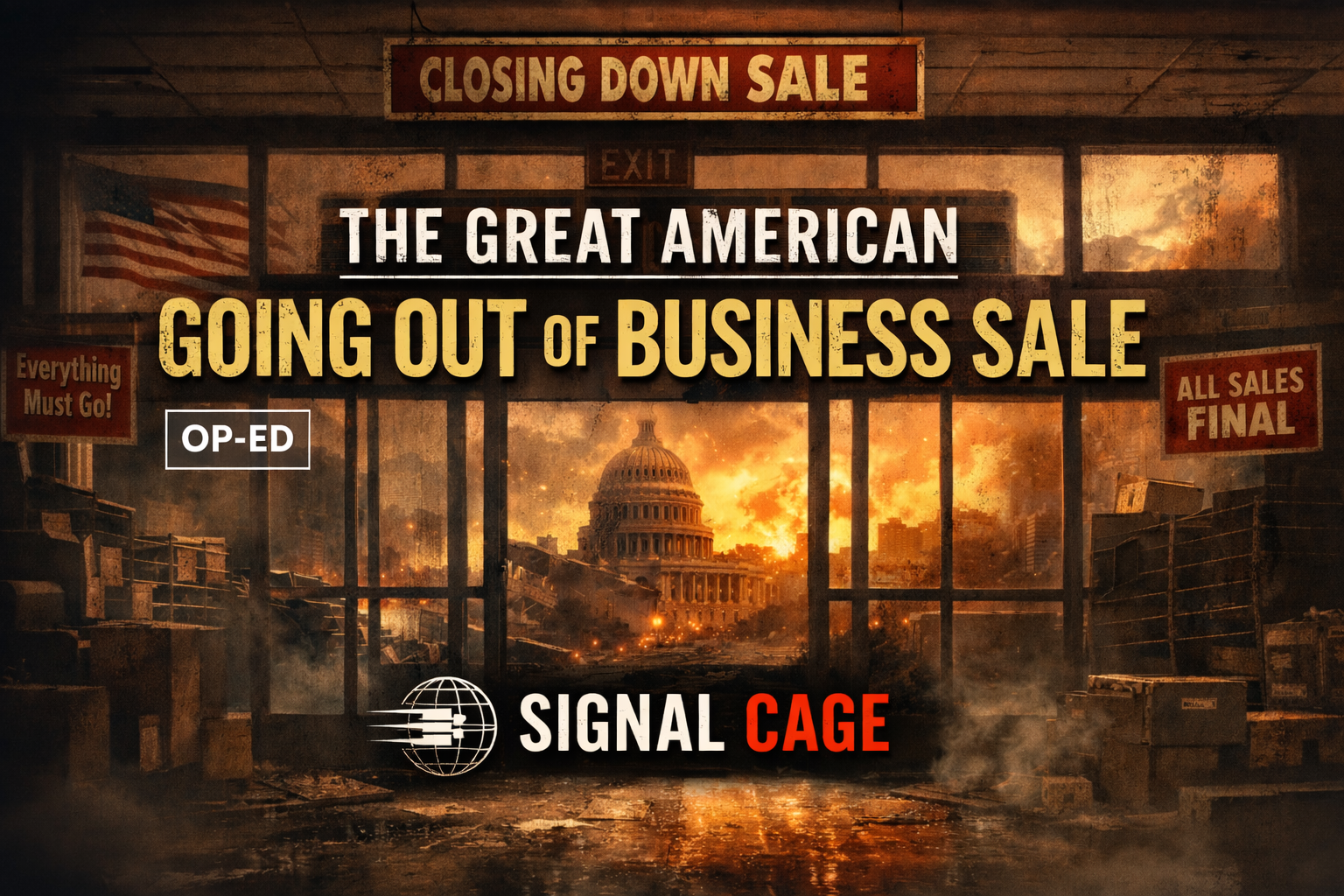
How institutional collapse, democratic backsliding, and executive overreach are liquidating the United States
John C. Cooper | The Signal Cage | February 1, 2026 | Op-Ed
Introduction
This is not a revolution.
It is a liquidation.
The United States is not collapsing in a single, cinematic moment. There are no tanks at the Capitol, no uniformed juntas, no formal suspension of the Constitution. The storefront is still open. The lights are still on. The registers still ring. But behind the counter, the inventory is being stripped, priced, and sold.
What is happening is better described as a going out of business sale of a republic—a managed wind-down of institutional legitimacy, public trust, and democratic norms. Courts still operate, elections still occur, and agencies still issue press releases. Yet the underlying assets that once made those systems meaningful—independence, accountability, shared reality—are being quietly liquidated.
Political scientists call this democratic backsliding. Economists would recognize it as asset stripping. Systems engineers would call it a slow-motion failure cascade. Together, it forms a pattern: a state legitimacy crisis disguised as normal governance.
This is what late-stage empire looks like in the digital age. Not collapse, but conversion. Not revolution, but restructuring. A constitutional order is being transformed into a holding company, where power is centralized, oversight is gutted, and public institutions are retooled for extraction rather than service. Executive overreach is no longer a scandal; it is a business model. Independent agencies are not abolished—they are hollowed, rebranded, and resold.
From the dismissal of inspectors general to the politicization of civil service, from election delegitimization to the normalization of coercion, the U.S. political crisis now resembles a corporate fire sale. Everything that once stabilized the system is marked down: truth, expertise, law, restraint. What remains is force—both symbolic and literal—the final asset when all others lose value.
This is not a prophecy. It is a balance sheet.
And the numbers no longer add up.
Inventory #1: Legitimacy — Marked Down to Nothing
How trust, truth, and shared reality became surplus assets
Legitimacy is the invisible capital of any political system. It is not written into law, but without it, law becomes suggestion. When citizens no longer believe that institutions are neutral, that outcomes are fair, or that facts are stable, the system does not immediately fail—it devalues. Like currency during hyperinflation, it still circulates, but it no longer commands faith.
The United States is now operating in a post-legitimacy environment. Courts are still open. Elections still happen. Government still speaks. Yet each institution is now branded, sorted, and trusted only by faction. The rule of law has been replaced by a market of narratives, where belief is no longer earned through process but purchased through identity.
This is a core feature of modern democratic backsliding: the erosion of shared epistemic ground. When “your truth” and “my truth” replace public truth, the system loses its reference point. There is no longer a neutral referee—only rival crowds shouting at the scoreboard.
Once legitimacy collapses, force becomes the only stable currency. Every authoritarian system, historical or contemporary, converges on this logic. When trust is gone, power must be seen, felt, and feared to be believed.
But the shift is subtle. Legitimacy is not revoked; it is discounted. Each scandal, each lie, each institutional purge reduces its value. Over time, the public stops expecting integrity and begins negotiating with coercion. The moral center of governance is replaced with transaction logic: compliance in exchange for stability, silence in exchange for survival.
This is not cynicism. It is structural decay.
And like all decay, it spreads quietly—until the building still stands, but no longer supports weight.
Inventory #2: Institutions — Stripped for Parts
How the state becomes a salvage yard
In healthy systems, institutions accumulate value. They store memory, expertise, and restraint. They outlast administrations, stabilize transitions, and absorb political shock. Their purpose is not efficiency, but continuity.
In late-stage systems, those same institutions are no longer seen as assets. They are seen as obstacles.
What follows is not reform. It is dismantling by conversion.
Oversight bodies are not abolished; they are rendered decorative. Career professionals are not fired en masse; they are isolated, sidelined, and replaced with loyal intermediaries. Independent agencies are not shut down; they are hollowed, merged, rebranded, and politically rewired. The machinery remains, but the safeguards are removed. It is governance by shell company.
This is how executive power expansion works in practice. It does not declare itself absolute. It centralizes function while dispersing blame. Authority is concentrated upward, while accountability is diffused outward. When failure occurs, no one can be held responsible, because responsibility has been structurally erased.
From inspectors general to regulatory commissions, from environmental protection to education, the pattern is consistent:
extract the value, discard the mission, preserve the logo.
The public is told this is efficiency. The markets are told this is deregulation. Supporters are told this is liberation from bureaucracy. But the outcome is always the same: institutions lose their internal resistance. They no longer restrain power; they transmit it.
This is what institutional collapse looks like when it is professionally managed. There are no dramatic endings. There are quarterly reorganizations. There are press releases. There are new mission statements that say everything and promise nothing.
The state does not disappear.
It becomes a distribution network for political will.
And like any network stripped of redundancy, it is now vulnerable to cascading failure.
Inventory #3: The Social Contract — Sold to the Highest Bidder
When citizenship becomes a subscription service
The social contract is the unspoken agreement that binds strangers into a public. It promises that participation grants protection, that labor earns dignity, and that law applies evenly. It is not written into any constitution, yet every constitution depends on it.
In a liquidation state, that contract is no longer honored.
It is monetized.
Public goods are reframed as inefficiencies. Collective obligations are reclassified as costs. What once belonged to everyone is carved into premium tiers. Security becomes a product. Justice becomes a service. Education, healthcare, infrastructure—each is detached from citizenship and sold back to the population at market rates.
This is not privatization in the classical sense. It is subscription governance. Access is conditional. Stability is rented. Protection is no longer a right; it is an upgrade.
Those who can pay remain visible.
Those who cannot are marked as unviable.
The language of efficiency masks a deeper transformation: the replacement of shared obligation with transactional logic. If you fail, it is not because the system is broken—it is because you were priced out.
Citizenship, once a mutual guarantee, becomes a risk category. Communities are scored. Neighborhoods are redlined by algorithm. Entire populations are redefined as fiscal liabilities rather than political stakeholders.
In this model, solidarity is not abolished—it is outsourced to charity, branding, and spectacle. Structural harm is reframed as personal failure. The public is told to optimize itself.
This is how a society learns to tolerate abandonment.
Not as injustice—but as market outcome.
Inventory #4: Violence as the Final Asset
When force becomes the only remaining currency
Every system has a final backstop. When legitimacy collapses, institutions hollow, and the social contract is sold off, there is only one mechanism left that still functions reliably: coercion.
Violence does not arrive as a rupture. It arrives as a utility.
At first it is procedural—riot gear, emergency orders, surveillance expansions, “temporary” powers. Each measure is framed as stabilization, each deployment as necessary. But as other forms of authority lose value, force quietly becomes the system’s most dependable asset.
This is not a descent into open war. It is the normalization of managed fear.
Police, federal agents, and security contractors become the shock absorbers for elite decisions. They stand between policy and consequence, between institutional decay and public reaction. They are tasked with enforcing a system that no longer persuades. Over time, they are no longer guardians of law but instruments of continuity.
Protesters, in turn, become moral exhaust—venting pressure the system cannot metabolize. The street becomes the final negotiation space for a government that has lost credibility in every other arena.
Each escalation feeds the next. Every confrontation justifies new tools, broader mandates, deeper data collection. Violence becomes self-renewing, because it now sustains the structure it claims to defend.
This is the terminal logic of liquidation:
when nothing else holds, force remains liquid.
The Employees Know — They Just Can’t Say It
Institutional grief in a managed decline
Every large system begins to fail from the inside before it fails in public. The first witnesses are not politicians or commentators. They are the employees.
Teachers rewriting curriculums that no longer match reality.
Nurses rationing care inside institutions designed for efficiency, not survival.
Analysts watching their reports buried.
Civil servants asked to implement policies they know will cause harm.
Journalists tracking narratives they are no longer allowed to name.
They feel it as procedural grief—the quiet realization that the mission has been replaced by optics, that integrity has become a liability, and that dissent is now a career risk. Meetings continue. Metrics are filed. The language of professionalism remains intact. But everyone senses the floor sagging.
This is not corruption in the dramatic sense. It is organizational bereavement. A mourning for institutions that still exist physically but no longer function ethically.
Inside the system, people stop asking “Is this right?” and begin asking “Will this protect me?” Survival replaces purpose. Silence becomes strategy.
The liquidation is not announced because those tasked with maintaining the appearance of stability are the first to recognize its absence. They know the store is closing. They just cannot say it out loud.
This Is What Late-Stage Empire Looks Like
Not collapse, but conversion
Late-stage empire does not resemble invasion footage or burning capitals. It looks like normal operations under abnormal incentives.
The roads are still paved. The banks still open. The courts still issue rulings. But the underlying purpose of the system has shifted. The state no longer exists to arbitrate the public good. It exists to preserve itself through extraction.
This is the defining feature of late-stage systems: everything becomes negotiable. Law becomes flexible. Truth becomes conditional. Loyalty becomes currency. Institutions no longer restrain power; they repackage it.
Collapse is noisy.
Liquidation is administrative.
What is happening is not a sudden break but a slow transformation of governance into an asset-management regime. Public authority is converted into a revenue stream. Political conflict becomes market segmentation. Social unrest becomes a growth opportunity for security and data industries.
The empire does not fall.
It rebrands.
And the more efficiently it rebrands, the harder it becomes to name what is being lost—until loss itself feels like the natural order.
There’s No Fire Sale Without a Fire
Who walks away with the fixtures
Every liquidation has beneficiaries. Assets do not disappear; they change hands. When a republic sells off its legitimacy, its institutions, and its social contract, someone acquires what remains. Power does not dissolve—it concentrates.
The fire is not an event. It is the cumulative heat of abandonment, coercion, and normalized decay. It is the pressure created when a society is told that nothing is sacred, everything is negotiable, and survival is a personal responsibility.
The danger is not that the store will close.
The danger is that people will mistake the clearance signs for prosperity.
Because when the lights finally go out, the shelves will already be empty. The employees will already be gone. The inventory will already be in private hands.
What remains will not be a republic.
It will be a ledger.
And the numbers will finally balance—
just not in the public’s favor.


1 comment
The American system of economics has one purpose. It is meant to enrich the lives of any person who cares to be enriched by the best and brightest ideas and creativity by their fellow man. The premise is not to take from one person and give to another, it is to create something beneficial that can be shared with others. What we are witnessing today in America is a return to the American system of economics that at one time drove America to become the greatest economy of our time. The difficulty in transitioning back is rebuilding the economic infrastructure that has been lost and most importantly, to reinvigorate the passion in people to drive the creativity and the economy to a new place. It may be that returning to a system that was successful in the past is no longer possible.