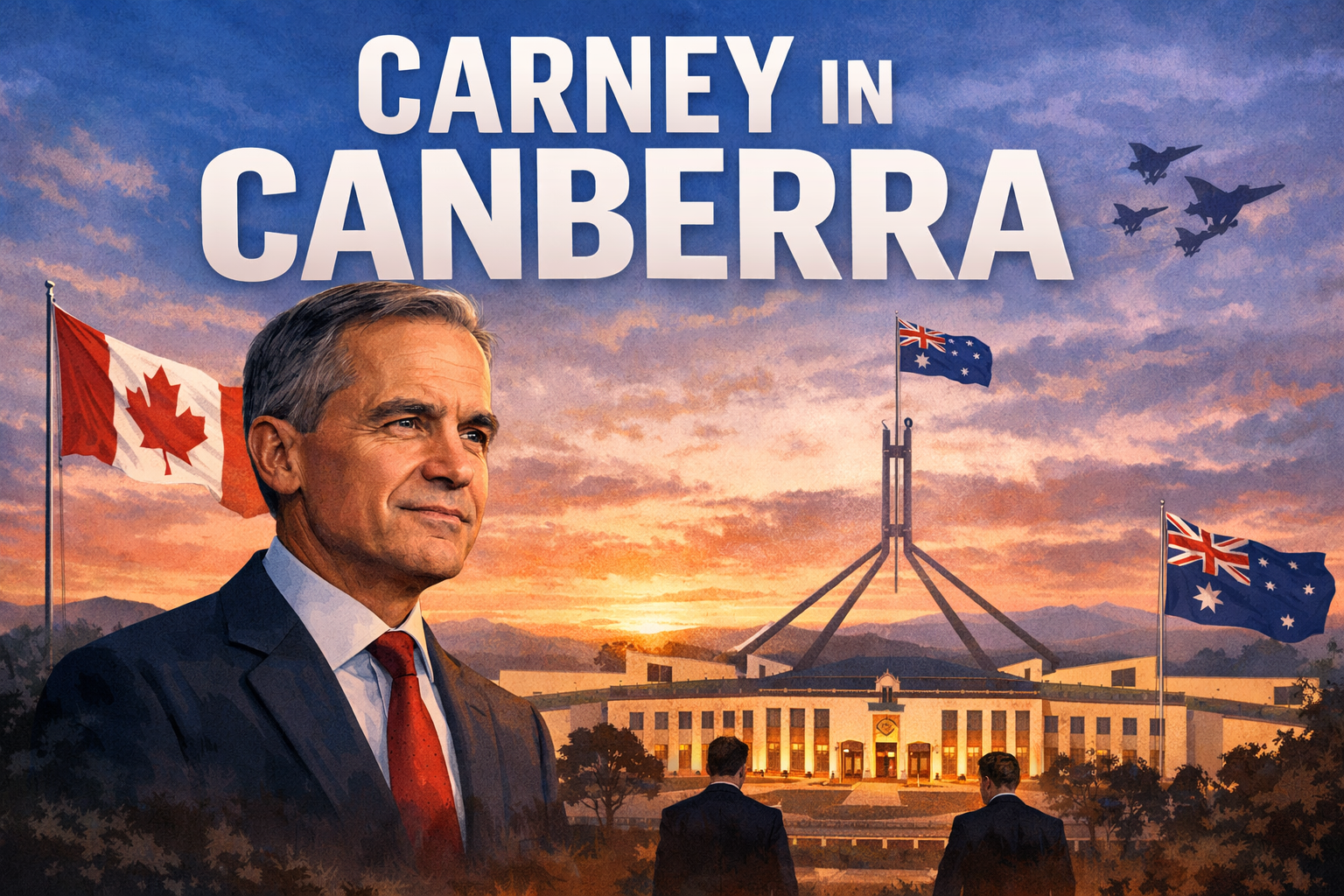
OTTAWA / SYDNEY — Canadian Prime Minister Mark Carney is confirmed to address the Australian Parliament in March, making him only the second Canadian leader in history to do so. The first was Stephen Harper, who spoke on September 11, 2007 — a speech framed around the War on Terror and shared sacrifice in Afghanistan. The context for Carney’s address could not be more different.
Australian Prime Minister Anthony Albanese confirmed the visit on January 25 during an appearance on ABC’s Insiders, stating plainly: “My friend Mark Carney will visit Australia with an address to the parliament in March.” Albanese offered no further details on date or agenda, but the framing was immediate and unambiguous. Asked about Carney’s January 20 speech at the World Economic Forum in Davos — in which Carney called on nations to accept the end of a rules-based global order and position middle powers as a counterweight to economic coercion — Albanese said: “I agree with him.”
That endorsement is not incidental. It is the news peg.
The Bilateral Foundation
The parliamentary address does not arrive in a vacuum. In October 2025, Canada and Australia signed a bilateral agreement focused on cooperation and trade in critical minerals, aimed at strengthening supply chains and supporting energy transition goals for both countries. No Canadian prime minister has visited Australia since 2014. The gap is telling — not because relations were strained, but because the relationship simply was not a priority for either side until the geopolitical calculus changed.
Carney and Albanese had already met in person at the Global Progress Action Summit in London in September 2025. That meeting preceded both the critical minerals agreement and the Davos speech. The sequence matters: the bilateral architecture was being built before Carney made his position public. The Davos speech did not create the alignment — it announced it.
Why Australia Is Receptive
Australia’s enthusiasm for Carney’s middle-power thesis needs to be understood in its own context, not simply as a reaction to Canadian rhetoric.
The AUKUS submarine arrangement — the trilateral security pact with the US and UK announced in 2021 — remains one of the most consequential defence commitments in Australian history. It also remains deeply uncertain. The US Navy is producing submarines at roughly 1.2 per year against a target of two, carries a chronic maintenance backlog, and has yet to demonstrate it can spare Virginia-class boats for transfer. A retired UK rear admiral has publicly warned that Britain lacks the skilled workforce to build and sustain its share of the programme. The submarines that were supposed to arrive are not arriving on schedule, and there is no credible public timeline for when they will.
Australian Treasurer Jim Chalmers called Carney’s Davos speech “stunning” and “very impactful,” adding that it had generated significant internal government discussion. Former Prime Minister Malcolm Turnbull went further, arguing that Albanese should deliver the same speech — warning that any nation economically integrated with the United States under current conditions would find that integration used as leverage against it.
This is not anti-American sentiment in the Australian context. It is a pragmatic reassessment by a government that has watched its most significant defence partnership deliver less than it promised, while simultaneously watching Canada articulate a framework for managing that exact problem.
The Parliamentary Address as Signal
A foreign leader addressing the Australian Parliament is a rare and deliberately weighted event. It is not a bilateral press conference or a summit sidebar. It is a formal address to the legislature of a sovereign nation, staged in Parliament House, and it carries symbolic weight that both governments understand.
Harper’s 2007 address was built around shared wartime history and the post-9/11 alliance. Carney’s will almost certainly be built around something else: the shared position of middle powers navigating a period in which the economic and security architecture that governed the post-1945 order is no longer functioning as advertised.
Whether Carney names the United States explicitly in that address — or, as he has done so far, keeps the critique at the level of “great powers” and “systems” — will be the key thing to watch. His Davos speech stayed at that level. The parliamentary address, in front of an allied legislature with no American officials in the room, is the first occasion where the political cost of being more direct drops significantly.
What This Looks Like From the Outside
The sequence across the non-US Five Eyes members over the past twelve months is now documented in public record. Canada pivoted to China and Europe. The UK signed a reset agreement with the EU. Australia invited Carney to address its parliament. New Zealand had already begun distancing itself from Five Eyes consensus positions on several issues prior to any of this.
These are not coordinated moves in any conspiratorial sense. There is no evidence of a back-channel agreement to shift simultaneously. What there is evidence of is four countries arriving at the same conclusion independently — that dependence on a single dominant partner creates vulnerability, and that the tools for managing that vulnerability need to be built, not assumed.
Carney’s March address in Canberra is the most visible single event in that pattern so far. It will not resolve anything. But it will make the pattern harder to dismiss.
Signal Cage reports on matters of public interest involving Canadian government institutions and international affairs. OSINT analysis by Prime Rogue Inc.


1 comment
[…] Mark Carney is going to Canberra. He is going to stand in the Australian Parliament and tell a room …It will be received well. The Australians will applaud. The coverage will be respectful. And it will not go nearly far enough. […]